Historiographic data and archaeological research allow us to build an appropriate historical picture of the continuity of life at Stobi and the events connected with the city.
The material remains from the Archaic and Classical periods, discovered through archaeological research, most probably mark the beginning of settlement at Stobi. Their small quantity and the lack of written sources do not allow more concrete conclusions about the character of the settlement and its size.
The first historiographic data on Stobi are found in Titus Livius (59 BC – AD 17), informing us that in 197 BC Philip V defeated the Dardanians near Stobi. A second record states that the river Erigon (Crna) flows into the Axios (Vardar) near the “old town” of Stobi. A third record by Livius concerns the Roman conquests in Macedonia and 167 BC, when Stobi became the main centre for the salt trade in the third meris. Archaeological research has located the fortified settlement and the necropolis from the Hellenistic period, allowing the continuity of the city’s development to be traced.
The salt trade and its favourable geographical position gave Stobi a constant rise through the centuries of Roman rule. Located at the crossroads between the Vardar highway and the Diagonal road, Stobi grew into one of the most important Roman cities in Macedonia. From the 1st to the 3rd century, during the pax Romana, Stobi experienced changes in urbanisation, demographic expansion and reached the largest area in the history of its existence. In the time of Augustus the city became an oppidum civium Romanorum, and later a municipium. Although the indigenous population was dominant, many citizens enjoyed Ius Italicum and belonged to the Aemilia and Tromentina tribes. During the reign of Vespasian (AD 69–79), Stobi began minting bronze coins for local use, which continued until Elagabalus (AD 218–222).
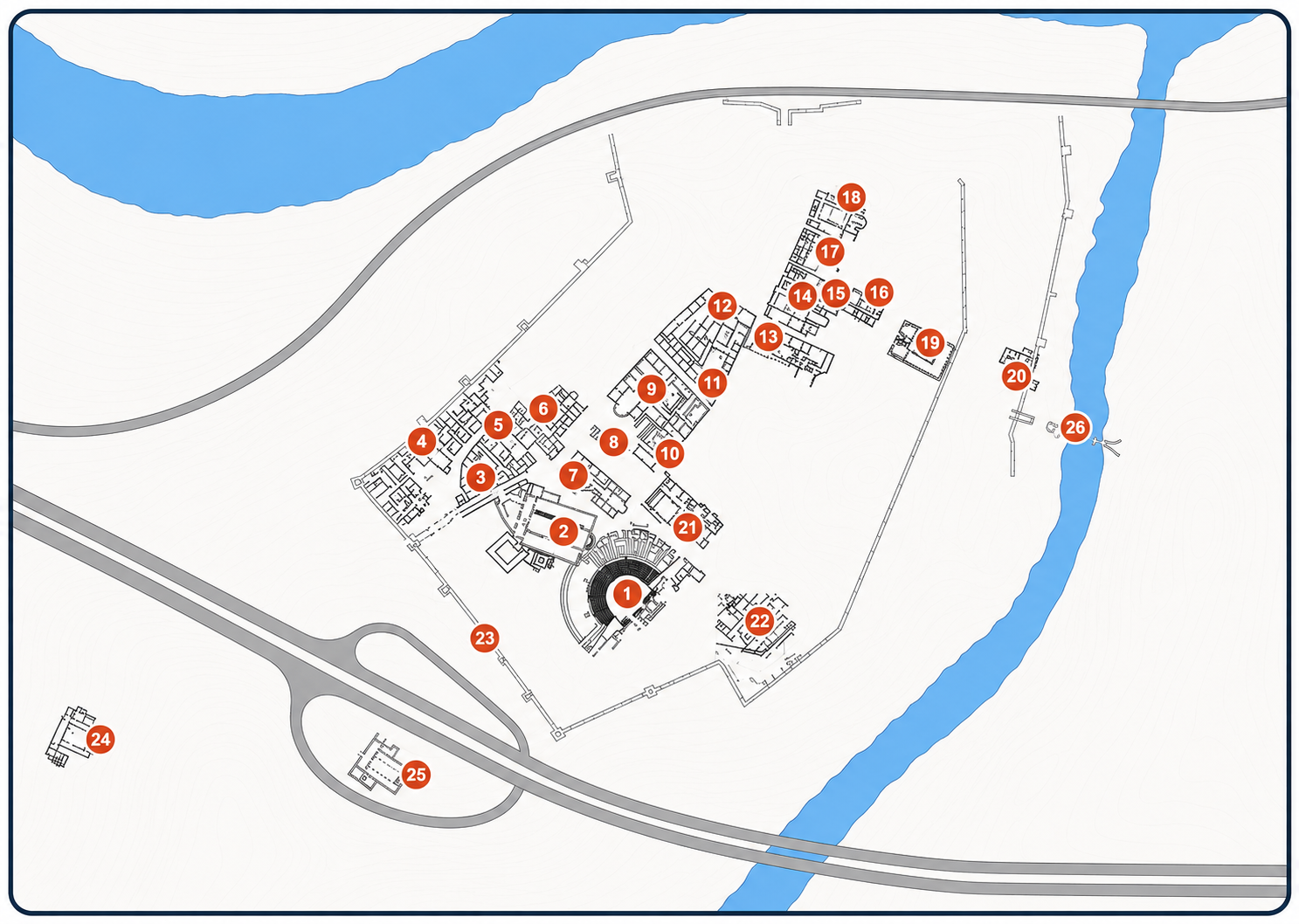
From the Early Roman period, the theatre, the rampart, the Porta Sacra or Porta Heraclea, the aqueduct, the synagogue, Casa Romana, parts of streets, parts of the civil basilica and the public building with arches have been discovered and documented. The archaeological data indicate that the city suffered in the second half of the 3rd century. Although an earthquake cannot be excluded, these destructions are usually associated with the campaign of the Heruli and Goths in 267/69, when other Balkan cities also suffered.
After the catastrophe the city was rebuilt, and in the period from the 4th to the 6th century there were many changes in urbanisation. Most of the structures visible on the ground today were built in this interval. At the end of the 4th or beginning of the 5th century, a new rampart was raised on the eastern side, west of the old one, passing over some of the Early Roman buildings from the 1st–3rd century.
One of the more significant events in the history of Late Antique Stobi is the formation of the Christian community. The name of the first bishop – Budius – is recorded at the Council of Nicaea in 325, and the old Episcopal Basilica dates from the 4th century. These are the earliest documented manifestations of Christianity in the Republic of Macedonia. In 388 the emperor Theodosius visited Stobi and issued two edicts here forbidding the gathering of heretics and public discussions about faith. The discovered sacred architecture at Stobi, and especially the Episcopal Basilica of Bishop Philip from the early 5th century, show that the city was a significant religious centre with established Christian traditions. The fact that Stobi was the capital of the province of Macedonia Secunda leads some researchers to believe it was not only a bishopric but had the rank of a metropolis. Bishops from Stobi appear as participants at Christian councils until the end of the 7th century, when the Stobi bishopric existed only nominally.
The most famous inhabitant of Stobi lived in the 5th century. His name is John of Stobi (Ioannes Stobaeus), known as an ancient author who compiled an anthology of four books of literature from Homer up to the 5th century. Thanks to his work, numerous excerpts from books that no longer exist have been preserved to this day.
In 447, Stobi, like seventy other Balkan cities, suffered from the Huns. This event, recorded in the sources, is documented through burnt layers dated by coins and the discovery of Hunnic weapons. It marks the beginning of turbulent times and the gradual dying of the city.
In 479, Theodoric and the Ostrogoths, on their way to Dyrrachium, plundered Stobi, but this attack did not have the consequences of the Hunnic one, and the city was rebuilt.
The migrations of the Slavs and the movements of the Avars, Kutrigurs and other tribes during the 6th century led to the devastation of cities across the entire Balkan Peninsula. At the same time, climatic changes negatively affected agriculture and living conditions. For these reasons, towards the end of the 6th century the city was abandoned, and the empty buildings were later destroyed by an earthquake.
In the Middle Ages, settlement of the Slavs in this area is recorded, but without any particular intensity of habitation, as witnessed by the discovered medieval graves.
© Copyright - NI Stobi
Powered by Elbosoft Consulting DOOEL
 +389 43 251 026